The “great filter” is the notion that the reason we do not already detect any sign of the development of a similar society, more advanced than our own, among the stars is that there is some sort of trap that causes self-aware intelligent societies to self-destruct. The intelligent society fails in some fundamental way and the trap is invisible until it is already doomed.
https://en.wikipedia.org/wiki/Great_Filter
The path to the waterhole is well traveled, and it is the easiest way through the jungle.
We developed to be what we are by using a neural net-based intelligence to control our bodies and model our environment so that we can predict and control or adapt to it.
Within the mind there is the model of the universe, where we can question what will happen if we press a button, and get an answer. Sometimes the answer is right. The smarter we are, the more often we are “right” and our ability to survive is enhanced. The more knowledge and understanding we have, ditto. There is a big survival advantage in knowing why things happen.
There is the perception of a button that can be pressed. The neural net perceives the world around it with the senses built into the body it controls, a control of a body that is physically able to push the button. We can read the label above the button. Knowledge is transferred.
The model of the body the net is able to control is included within the model. What it does in the model is imaginary, but its existence allows the neural net to select the actions that offer us the greatest benefit, the greatest control over the energy we are converting into entropy.
This is apt for many animals. They do not develop the sort of self-awareness or identity that we recognize. Humans, however, survive as cooperative societies and communicate with one another. This leads us to need names. It leads us to put labels over buttons. It populates our internal models with others like ourselves, and demands that we be part of the society. We have evolved internal rewards for love and companionship, our emotions, to ensure that we try to stay close to our supporting society. We share.
The development of all of these things in that internal model, of the traits that apply to the body controlled by the neural net, creates the unique self-aware “person” that we know as us. Being a Neural-Net means that it has to learn and be continually trained to maintain the distinctions between the modeled inputs and outputs of its internal model, and the real-world inputs of its senses and outputs of its muscles. We have to sleep, disconnected from the real world, and dream.
Hypothesis
The development of the intelligence that results from not only having this personal “ego” develop, relies on a community of social entities that cooperates and communicates to survive. This will be the case for any entity, human or alien, that is “smart like us.”
Our rapid development from the invention of the steam engine to our landings on the lunar surface, is all based on the consumption of previously stored energy resources. Our problem is that we compete, as societies, for those resources, and it is a competition in which size matters. The society that grows most quickly, wins.
I believe that this too, is a property of any entities, human or alien, that develop to be “smart like us.” The society that uses money in consumption, production, and trade has the advantage of being able to be much larger than one that is limited to the number of people we can perceive as being part of our group. Is this limit common? Perhaps. Dunbar’s number may be a function of the limitations of hominid brains, but our ability to lie came with our ability to communicate, and the necessity of trusting the members of a society seems to be philosophically inseparable from the problems of liars and free-riders.
The point to the last paragraph is that money IS a tool for any society that grows larger than it’s species specific “Dunbar’s Number.” It allows members to exchange work and products without needing to employ barter. The larger society survives more easily. Darwinian principles apply.
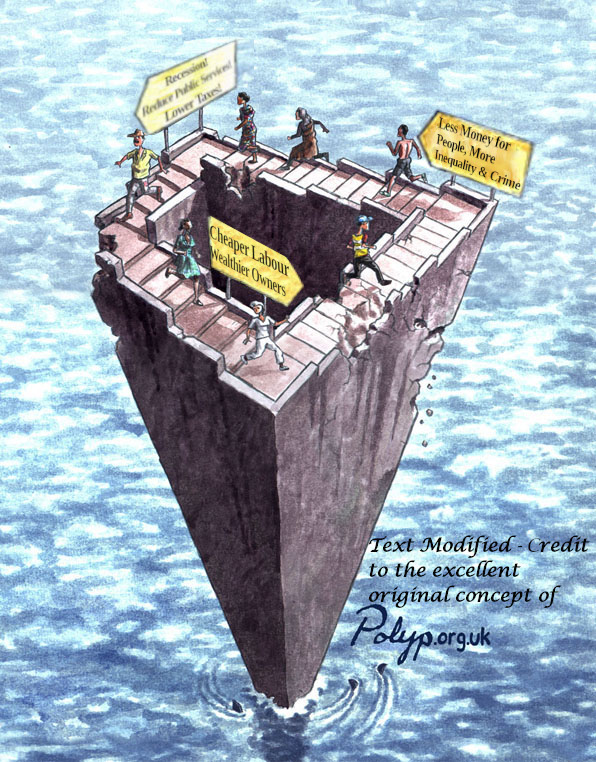
But when the money itself demands growth, the society grows more rapidly, and is thus even more likely to survive. So the error of a monetary definition that is based on debt with interest is, until the planetary limits are reached, quite adaptive. This is the definition favored by Darwin… until those limits are reached, and breached.
So every species, anywhere in the universe, that evolves as we do, to be “smart like us,” will have adopted a monetary definition that emphasizes growth at the expense of almost every other consideration, and will as a result lay waste to their environment in much the same way we have, and collapse.
Within centuries. The blink of an evolutionary I.



 Making Money Real
Leave a comment