WORK 01
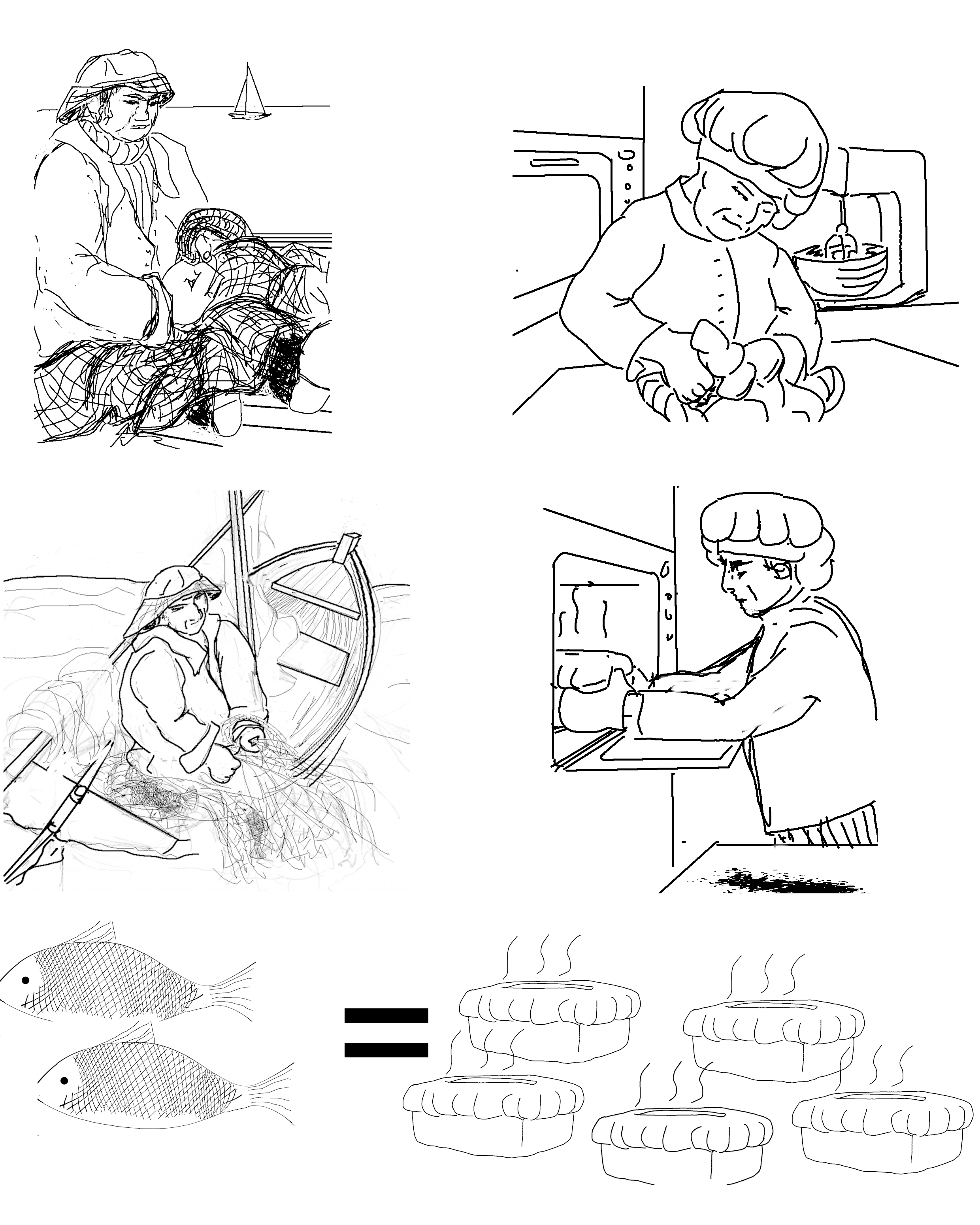
Illustration of the exchange of work done
A fisherman mends nets, goes to sea in a boat, and catches fish. A baker mixes dough, kneads it, and bakes bread. The work to obtain 2 fish is equal to the work to bake 5 loaves. Work, not a promise of work, is what is truly exchanged in a barter transaction.
WORK 02
The Economy and Energy
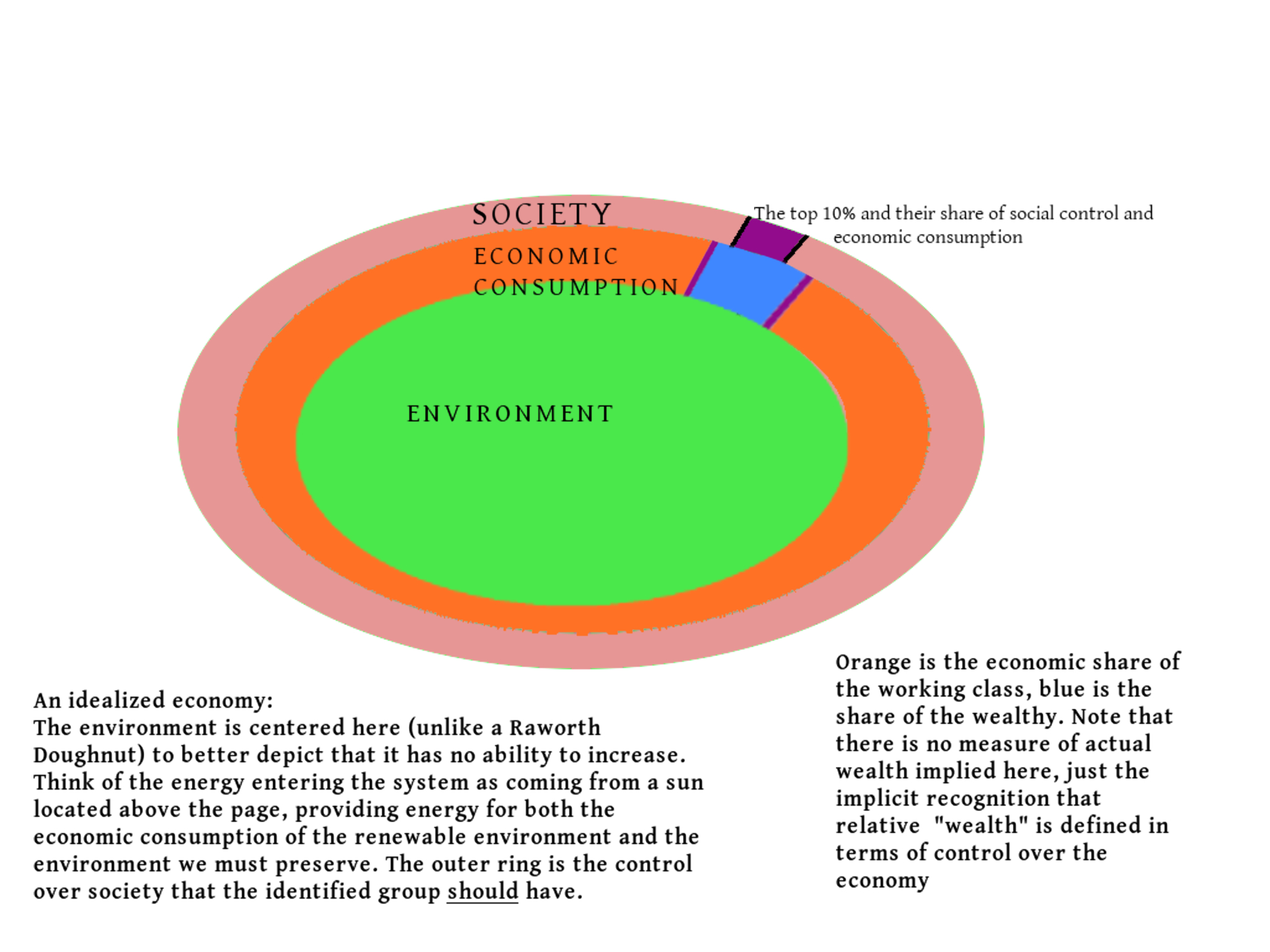
The 3 concentric ovals of an idealized socio-economy.
| Property | Communism | Socialism | Mahinism | Capitalism |
| Basic philosophy | Government does not exist (the state will “wither away”). Cooperation replaces government. “From each according to abilities, to each according to needs.” Ownership is removed. | Government has priority and is trusted. Cooperation Democracy is desired but inconvenient to the owning class. Taxation & wealth transfer stop the owning class from establishing plutocracy or oligarchy. | Government has priority and is trusted. Cooperation Democracy is desired and protected by money that is subject to the laws of thermo-dynamics. Ownership cannot be a source of money. | Government is secondary to individuals and is distrusted. Competition. Democracy is desired but inconvenient to the owning class. The owning class can establish a plutocracy and always does. |
| Money | Communism asserts that no money is required. | Money is required and it is “an idea.” Money is created as debt with interest (usually by bankers). | Money is required and represents work controlled by the society. Money is created by the state with built-in demurrage and loaned without interest. | Money is required and it is “an idea.” Money is created as debt with interest by bankers. |
| Payment for work (risk of wage slavery) | Depends on the state, with differentials for productivity and social supports for those who cannot work. | Depends on private negotiation or public wage settlements for industry sectors. Social support for those who cannot work. | Depends on the state, with differentials for skill and productivity. Social support for those who cannot work, plus a UBI. | Depends on private negotiations between the worker and employer. Social supports are minimized so that wages can be suppressed and workers forced to take jobs. |
| Market vs state control (risk of market failure or autocracy) | Centrally planned economy. Black market with scarcity pricing. | Essential portions of the economy are controlled by the state (Health, Education, Energy). A free market with scarcity pricing. | Essential portions of the economy are controlled by the state (Health, Education, Energy). A free market limited to cost pricing is established. | Market domination of all sectors of the economy. A “free” market with scarcity pricing and potential monopolies. |
| Consumption of the environment | Driven by a politically motivated need to grow. | Driven by profit motive & protected by government regulation. Resources are rationed by wealth. Growth is a sacrament. | Driven by necessity. Protected by regulations, the reduced need to grow, and the lack of profit through exploitation. Resources NOT rationed by wealth. | Driven by the profit motive. Protection by government regulation is resisted. Resources are rationed by wealth. Growth is a sacrament. |
| Ownership of and profit from economic resources | State (public) ownership & profits. | Mixture of public & private ownership & profits. | Mixture of public & private ownership. ONLY public profit is permitted. | Private ownership & profit. |
| Class | Class is abolished. The ability to earn more than other workers is reduced. | Classes exist but differences are diminished. Inequality is bad but is still based on ownership. | The owning class is abolished. Inequality due to effort, skill, and talent (but not ownership) is good. | The owning class is dominant, controls everything, and runs the government. Inequality is good & based on ownership. |
| Public information | Controlled and funded by the state. Fully censored. No way of knowing what is true or not. | Privately owned media & advertiser funding. Some social censorship. Some public funding for media. No way of knowing what is true or not. | State vouchers for full subscription services with almost no censorship and little advertising. ALL media is labeled to indicate the degree with which it promotes fact vs fiction. | Privately owned & advertiser-funded media. Some social censorship. Scarce public funding for media. A myth of merit-based class distinction is promoted. No way of knowing what is true or not. |
| Taxes | No money, so no taxes. (This has not been seen in the real world.) | Consumption and all forms of work based income are taxed. (Heavy taxes vs capitalism). Wealth-transfer is normal. Vice taxes (alcohol, cigarettes, weed) are used to discourage self-destructive behavior. The state is funded by taxes & debt. | Vice taxes (alcohol, cigarettes, weed) are used to discourage self-destructive behavior. Ownership Income taxed at 100%. Wealth transfer is not required. The state is the source of money and does NOT need taxes to fund itself. | Consumption, income and all forms of work-based income are taxed, and taxed more than capital gains. Wealth transfer is regarded as evil. Vice taxes (alcohol, cigarettes, weed) are used to discourage self-destructive behavior. The state is funded by taxes & debt. |
| Distribution of economic production | Production is distributed to the people at no charge. | Production is priced according to scarcity and distributed according to wealth, with social support for the poorest. | Production is priced according to cost, and access during scarcity is managed by the society; it is not rationed by wealth. | Production is priced according to scarcity and distributed according to wealth with minimal social support. |
 Making Money Real