Our money is evolving as debt; it represents debt, and at this late date, debt with interest. It has been evolving as debt for 5000 years, and David Graeber explained this evolution in detail.
But evolution does not confer correctness on a definition. Indeed, evolution is a process of trial and error, and the errors are eliminated without mercy.
Money is almost universally regarded as a claim on a nation’s wealth: an idea we share, and this makes sense to us because debt is an idea. Everybody knows what money is.
“It Ain’t What You Don’t Know That Gets You Into Trouble. It’s What You Know for Sure That Just Ain’t So” – Josh Billings.
What if money really represents something else?
If a fisherman and a baker meet on a road and exchange 2 fish for 5 loaves, they are not swapping ideas. If the baker had money, not loaves, the fisherman would not go home to chew on a conjecture offered by someone he’d never met. Money as debt correctly abandons barter as an origin story, just as Graeber explains. It also incorrectly eliminates trade without trust, carelessly abandoning the simplest possible exchange of goods.
“Money is a commodity—and it can be anything—that a society agrees to accept in exchange for every other commodity or service within that society. It ultimately represents the work the holder of the money exchanged with that society to get it.”
Ideas are not subject to the Laws of Thermodynamics; work is.
And if money represents work, it must also be subject to those laws.
And it turns out that the Laws are radically anti-capitalistic.
Nor is this understanding in conflict with the basic truth of Modern Monetary Theory (MMT). That requires explanation, and that explanation is here:
https://makingmoneyreal.org/2026/07/26/the-role-of-mmt-in-mahinism/
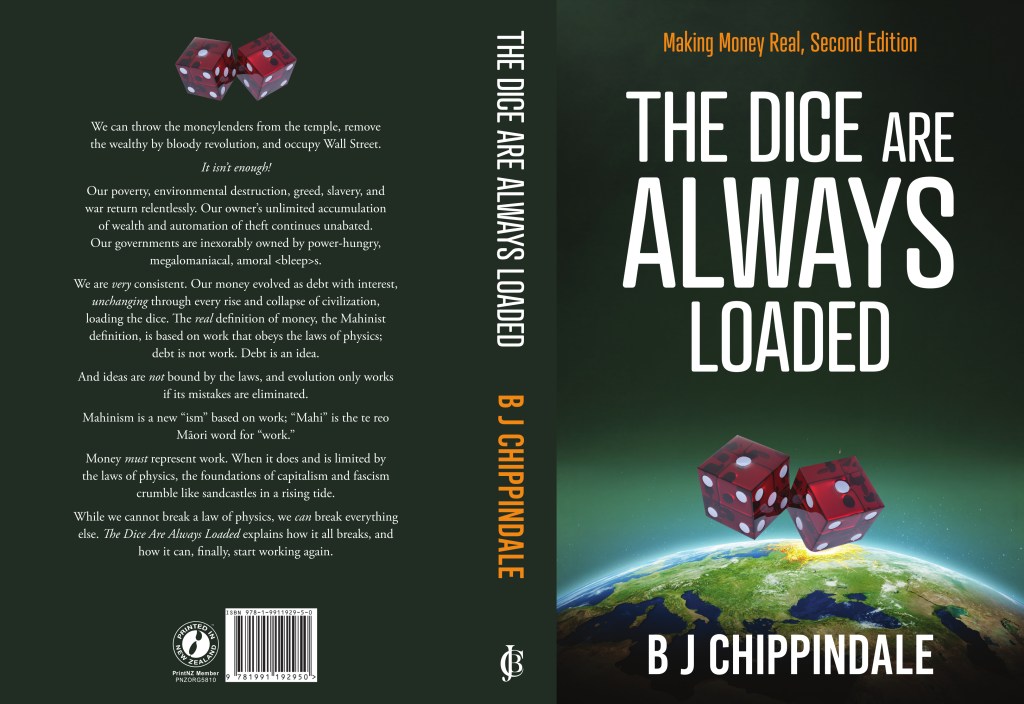
In The Dice Are Always Loaded, I offer a different understanding of money and ownership. This connects money to the laws of the universe and overturns the money tables in the temple of Mammon. War, Inequality, Overconsumption, Environmental devastation, Planned Obsolescence, and Slavery- all the messes our human societies keep making can be found here.
Most essays about our terrible problems end there and offer no real solutions. After providing the evidence and logic for its definitions, The Dice Are Always Loaded discusses in detail how a functioning human society operates within the laws, from advertising to farming to delivering truthful news to an entire society.
I call the resulting socio-economic system “Mahinism,” because “Mahi” is te Reo Māori for “work.”
To understand better just how disruptive this understanding is, here are the Laws as they apply to money.
First Law: Ownership of anything cannot make money. Conservation of Energy applies.
Second Law: Money cannot be a lasting store of value. Entropy applies.
Consider the business model of a bank: it collects interest on the money it loans to you because it owns the money it lends to you.
Consider the business model of a Landlord, who collects rent without doing work. A society that rejects these things is possible, but it is very different from what we do today.
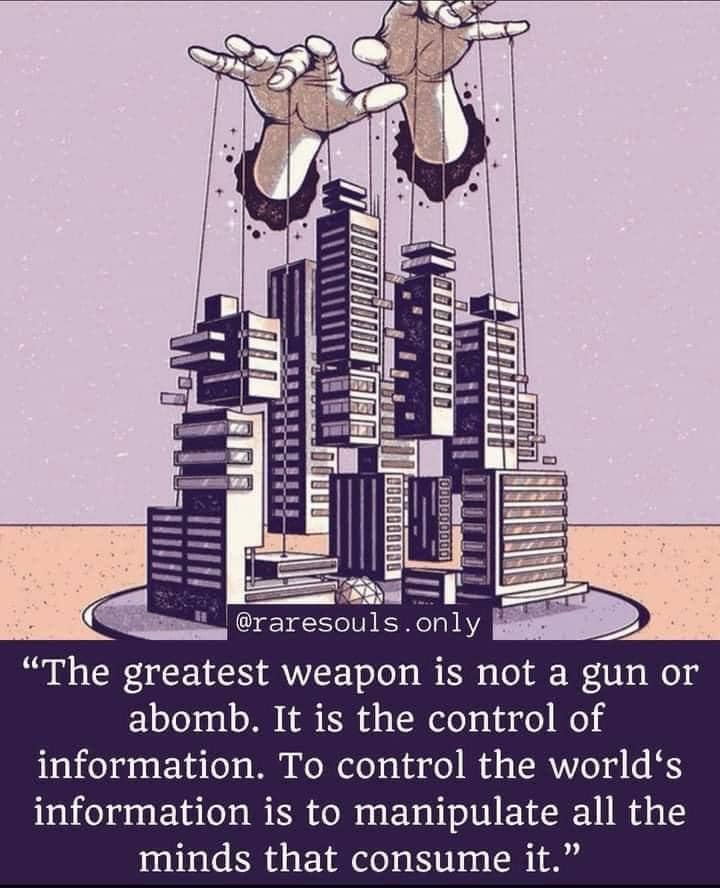
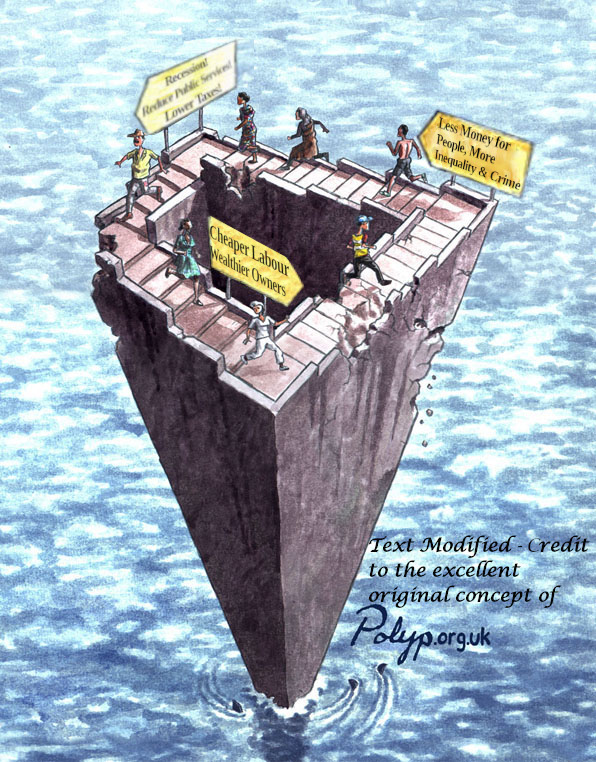
We are paying people who are not working for their ownership of the things we need to live. As a result, they have massive piles of money with which to purchase Members of Parliament, Senators, Congressmen, Supreme Court Justices, and Presidents. They own our laws, and when that is not sufficient, they buy our news media to ensure we never see the truth.
It needs to stop.
The people in the owning class are not all bad, but “the love of money is the root of all evil” is one of the basic truths of our major religions. The problem is not the people; it is the existence of the massive piles of money and the ease with which they corrupt even the best governments.
The Dice Are Always Loaded draws on many sources, but it was first written by an engineer using only the Laws; that was 15 years ago, and the author cites several previous efforts. It is not the first attempt to correct our error in defining money, but it may be the last chance for human civilization before nature erases our mistake.
=================
This is, technically, the second edition of “Making Money Real.” It exists because self-help books about money are ignored by people who might be interested in dismantling Capitalism. References on this site may include aspects of the first book. This post, however, becomes the anchor for everything else I do.
The book is to be published through “YourBooks” in New Zealand, and as an ebook through “Draft2Digital” elsewhere in the world. Greyscale images if you do not have a color reader.
Update 28 August – The e-book versions are already out.
Print will be a few days more.
The errata pages will change over shortly.


 Making Money Real
Leave a comment